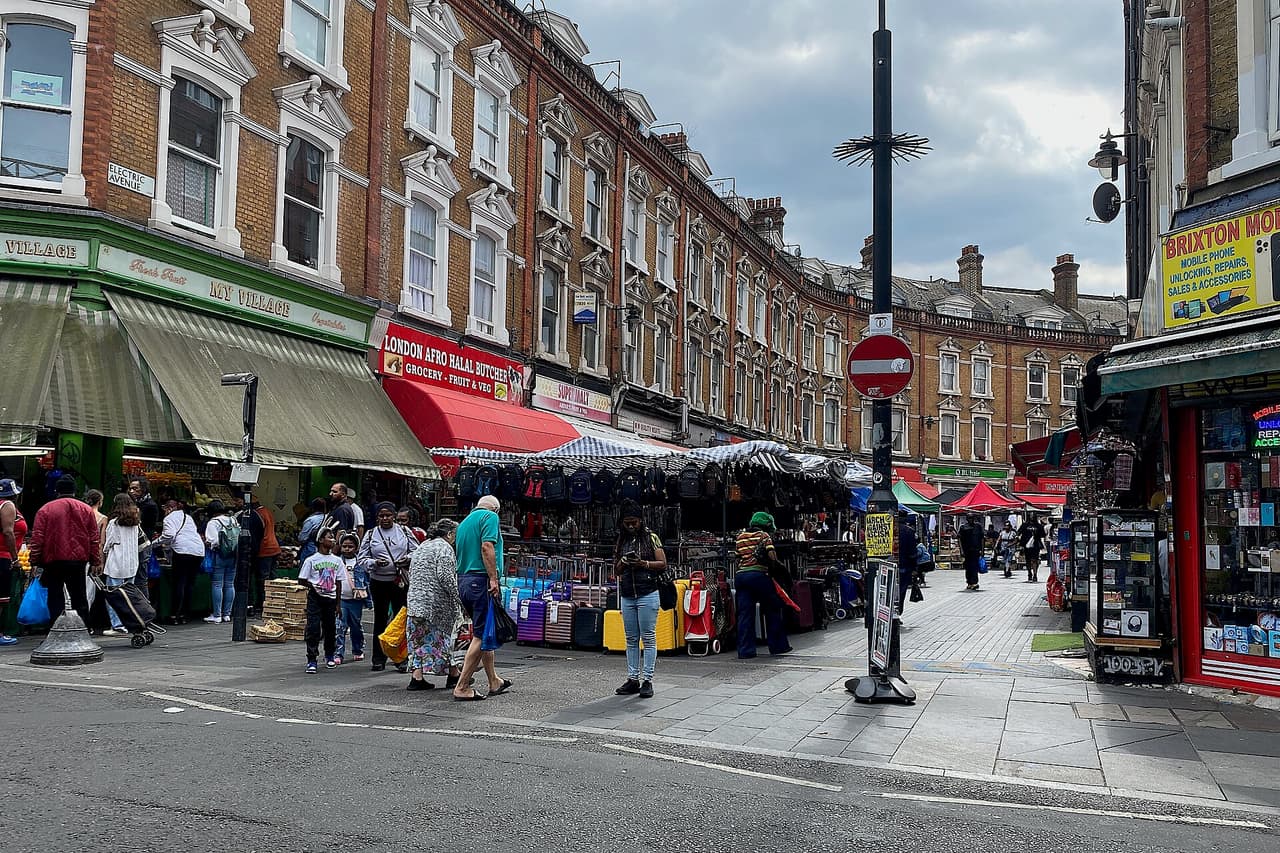
Brixton — the area associated with Olive Morris

Pictured: Robin Stott, CC BY-SA 2.0

No free portrait

Activism

Olive Morris

Community organiser and housing rights campaigner

Brixton Black Women's GroupLambethWandsworthSources cited

Olive Morris was a Brixton organiser who squatted 121 Railton Road, co-founded the Brixton Black Women’s Group and helped found OWAAD before her death at 27 in 1979. English Heritage put a blue plaque on her Railton Road home in 2024.

Early life

Olive Elaine Morris was born on 26 June 1952 in Harewood, Jamaica. In 1961 she and her brother came to Lavender Hill in south London to join their parents and younger siblings (English Heritage). At Lavender Hill secondary modern she was among the latecomers whose names a prefect, Beverley Bryan, had to write down; the two became friends and later fellow organisers (The Guardian).

In November 1969, aged 17, she stepped in when police in Brixton handcuffed Clement Gomwalk, First Secretary at the Nigerian High Commission, ignoring his diplomatic number plate. She was beaten, racially abused and held for several hours at Brixton police station. Around then she joined the Youth Section and Sisters’ Collective of the British Black Panther movement (English Heritage), and in 1970 it was Morris who first told Bryan about joining the Panthers (The Guardian).
121 Railton Road

In the winter of 1972–3 Morris and Liz Obi squatted 121 Railton Road, a three-storey end-of-terrace house built around 1870. It is widely regarded as the first successful squat of a private property in Lambeth, and the two women saw off several illegal attempts to evict them (English Heritage). A photograph of Morris climbing the building appeared in the Squatters’ Handbook, a copy of which was shown in the V&A’s Disobedient Objects exhibition in 2014–15 (Remembering Olive Collective).

The house became a base. A women’s study group and the Brixton Black Women’s Group met there (English Heritage), and it went on to house Sabarr, a Black community bookshop (University of Bristol). After the landlord took legal action, Morris and Obi moved to a council-owned squat at 65 Railton Road, where the group kept meeting. From the 1980s number 121 was the 121 Centre, and its final eviction in 1999 was said to end the longest-running squat in Britain (English Heritage).

“Olive Morris was ahead of her time as a courageous activist for women, for black people, for the poor and for the homeless.”

Councillor Sonia Winifred, Lambeth Council, 2020

Organising in Brixton

Morris was a founding member of the Brixton Black Women’s Group, which grew out of a 1970 study group of women from the Black Panthers, the Black Liberation Organisation and the Race Today Collective (English Heritage). Bryan dates its founding by Morris, Obi and herself to 1973, as the Panthers disbanded (The Guardian). In 1972 Morris, Darcus Howe and Abdul Macintosh were prosecuted after a protest outside the Old Bailey; they won the right to fair representation of Black people on the jury, and “the Old Bailey three” were acquitted (English Heritage).

Her campaigns ran from opposing the Vietnam War to supporting liberation movements in Mozambique, South Africa and Zimbabwe and workers’ movements in the Caribbean, and she helped homeless families who could not get social housing (English Heritage). The Brixton Ad-Hoc Committee against Police Repression was run from her squat at 2 Talma Road (English Heritage).

Manchester and OWAAD

In 1974 she began a social science degree at Manchester University, where she joined the Manchester Black Women’s Co-operative and the Black Women’s Mutual Aid Group (English Heritage). She campaigned to abolish fees for overseas students and set up a supplementary school for Black children (University of Bristol). She visited Italy and Northern Ireland in 1976, and in 1977 travelled to China with a student group organised by the Society for Anglo-Chinese Understanding, then wrote about China’s part in anti-imperialist struggles for the Brixton group’s newsletter, Speak Out! (English Heritage).

In 1978 she co-founded the Organisation of Women of African and Asian Descent (OWAAD) with Stella Dadzie and others (English Heritage). With her partner Mike McColgan she wrote an article arguing that the Anti-Nazi League overlooked institutional racism in the police, schools, local government and trade unions (English Heritage).

Back to Brixton

After graduating from Manchester in 1978 she came home to work in the juvenile department of the Brixton Community Law Centre, campaigning against the “sus” laws (English Heritage). That summer, cycling in the Pyrenees with McColgan, she became ill. She was diagnosed with non-Hodgkin’s lymphoma and died at St Thomas’ Hospital in Lambeth on 12 July 1979, aged 27. She was buried at Streatham Park Cemetery (English Heritage).

What remains

In 1986 Lambeth Council named its new offices on Brixton Hill Olive Morris House (Lambeth Council). Lambeth Archives now stands on the site, with a reading room named after her and a memorial stone unveiled in September 2023 (Lambeth Council). The archives hold the Olive Morris Collection, launched in 2009 by the Remembering Olive Collective, which recorded 30 oral history interviews, set up the Olive Morris Memorial Awards for young women activists of African or Asian descent, and published the anthology Do You Remember Olive Morris?

She appeared on the first edition of the Brixton Pound, the local currency; a note is in the Black Cultural Archives. The artist Linett Kamala made her the subject of an exhibition at Lambeth Town Hall in 2019–20 (Google Arts & Culture), and a Google Doodle by Matthew Cruickshank marked her 68th birthday on 26 June 2020 (Lambeth Council). In 2024 English Heritage put a blue plaque on 121 Railton Road reading “Anti-racist, feminist and housing rights activist lived here” (plaque record).

Highlights

c. 1969

joined the Youth Section of the British Black Panther movement (source)

1972

acquitted as one of “the Old Bailey three” with Darcus Howe and Abdul Macintosh (source)

1972–3

squatted 121 Railton Road with Liz Obi (source)

1973

co-founded the Brixton Black Women’s Group with Liz Obi and Beverley Bryan (source)

1974

began a social science degree at Manchester University (source)

1978

co-founded OWAAD and joined the Brixton Community Law Centre (source)

1986

Lambeth named Olive Morris House after her (source)

2009

the Olive Morris Collection launched at Lambeth Archives (source)

2020

Google Doodle on what would have been her 68th birthday (source)

2024

English Heritage blue plaque at 121 Railton Road (source)

Listed editorially. Olive Morris is not affiliated with BLACK LDN and has not endorsed it. Request a correction.

Also in culture

law

Doreen Lawrence

Campaigner, charity founder and peer
Stephen Lawrence Charitable Trust

Her campaign after her son Stephen’s murder forced the 1999 Macpherson report on police racism. She built a trust and a centre for young people and sits in the Lords.

Greenwich

law

Patricia Scotland

Barrister, Attorney General and Commonwealth Secretary-General
Former Attorney General; former Commonwealth Secretary-General

Grew up in Walthamstow, became the first Black woman QC in 1991, the first woman Attorney General in 2007 and the first woman to lead the Commonwealth Secretariat.

Waltham Forest

creative

Little Simz

Rapper, songwriter and actor
Age 101 / Forever Living Originals

Islington rapper who won the 2022 Mercury Prize and a BRIT for best new artist on her own Age 101 label, then curated the Southbank Centre’s Meltdown in 2025.

Islington