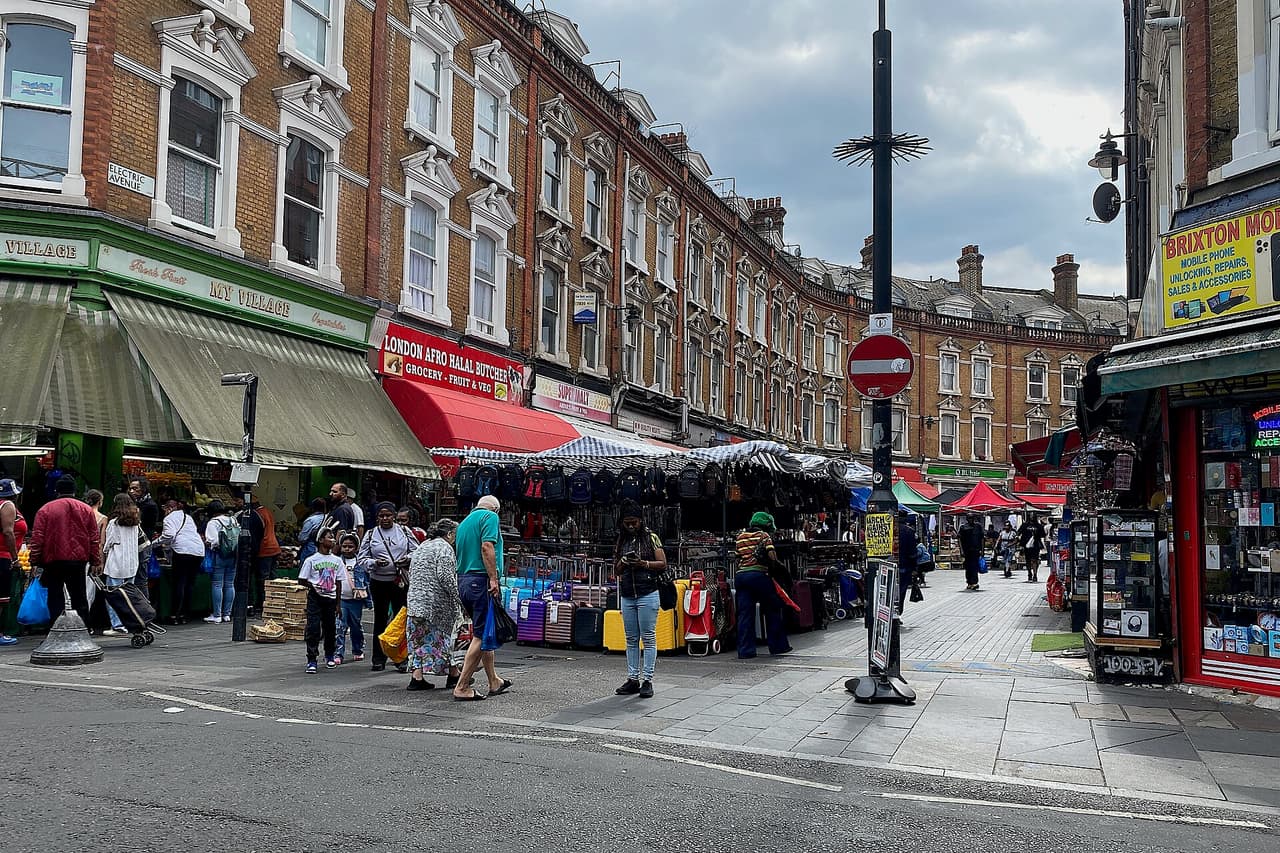
Brixton — the area associated with Darcus Howe

Pictured: Robin Stott, CC BY-SA 2.0

No free portrait

Activism and media

Darcus Howe

Broadcaster, editor and campaigner

Race Today, Railton RoadLambethKensington and ChelseaLewishamTower HamletsSources cited

Darcus Howe was a Trinidad-born campaigner, editor and broadcaster who worked for more than five decades for justice for Black Britons. He defended himself as one of the Mangrove Nine, ran Race Today from Railton Road, led the 1981 Black People’s Day of Action and took that politics onto Channel 4.

Early life

Leighton Rhett Radford Howe, known as Darcus, was born on 26 February 1943 in Moruga, Trinidad (London Remembers). His mother Lucille and father Cipriani were his first teacher and headteacher at Eckel Village primary school, and he won a scholarship to Queen’s Royal College in Port of Spain. His uncle was the historian C. L. R. James (Irish Times).

He came to London in 1961, aged 18, intending to study law (Nub News). Unwilling to accept being a “second-class citizen”, he gave up law for Black Power politics and radical journalism (Irish Times), and joined the British Black Panthers (The Guardian).

The Mangrove Nine

In August 1970 Howe, Altheia Jones-LeCointe and the British Black Panthers organised a campaign to defend the Mangrove, the Notting Hill restaurant run by Frank Crichlow, after police tried to close it (Irish Times). On 9 August about 150 people marched against police harassment in Notting Hill, and violence broke out between police and marchers (The National Archives).

Nine people were tried at the Old Bailey in 1971. Howe and Jones-LeCointe defended themselves, and Howe cited Magna Carta to demand an all-Black jury, which the judge refused (Irish Times). After 55 days all nine were acquitted of the most serious charges, and Judge Edward Clarke said the trial had “regrettably shown evidence of racial hatred on both sides” (The National Archives). In 2020 Steve McQueen dramatised the case in Mangrove, with Malachi Kirby as Howe (BFI).

“He was able to translate the struggles and the concerns of the black community into effective political action”

Leila Hassan Howe, at the unveiling of his plaque, 2022

Race Today

In 1973 Howe founded the Race Today Collective (Irish Times). Race Today had been a formal academic journal of the Institute of Race Relations; from 1974, with Howe as editor, it became a campaigning paper run by a collective that included Leila Hassan, later his wife, Farrukh Dhondy, Mala Sen, Barbara Beese and Linton Kwesi Johnson. It backed Asian strikers at Imperial Typewriters in Leicester in 1974, which Howe called “one of the most powerful strikes of the time”, reported the Grunwick strike in 1976, and worked with the Bengali Housing Action Group to find empty homes for families facing racist attacks (Tribune). The squat it helped create in Tower Hamlets was called the largest in Europe (Irish Times).

The magazine was edited and published from Railton Road in Brixton, where a plaque now records the years 1973–1988 (London Remembers); Leila Hassan took over as editor in 1985 (Black History Walks). C. L. R. James lived in the flat above the office (English Heritage). In 1977 Howe became the first democratically elected chair of the Notting Hill Carnival (The Guardian).
New Cross and the Day of Action

After the fire at 439 New Cross Road killed 13 young Black people on 18 January 1981, Howe and John La Rose led the New Cross Massacre Action Committee (Tribune). Under the slogan “13 dead, nothing said”, campaigners challenged the police handling of the case and pushed for proper media coverage, and on 2 March 1981 they held the Black People’s Day of Action (London Museum). About 20,000 people marched from New Cross in Lewisham to Fleet Street, Westminster and Hyde Park Corner (Tribune), in what the Irish Times called the largest political demonstration by Black people in Britain.

Television and journalism

Channel 4 took him to a national audience. He worked on Black on Black, co-edited The Bandung File with Tariq Ali from 1985 to 1991 after Farrukh Dhondy commissioned it, with Linton Kwesi Johnson among its reporters (LKJ), and fronted the current affairs series The Devil’s Advocate from 1992 to 1996. His documentaries included White Tribe (2000) and the three-part Slave Nation (2001) (Irish Times).

He wrote a column for the Evening Standard in the 1990s and for the New Statesman for more than a decade (Irish Times), and also wrote for The Voice (The Guardian). After his prostate cancer diagnosis in 2007 he worked with the NHS and Channel 4 to persuade Black men to get checked, and late in life he advised the makers of the Sky Atlantic drama Guerrilla (Irish Times).

In Brixton

Howe lived in Brixton for 30 years (The Guardian) and died in his sleep at home in Streatham on 1 April 2017, aged 74 (Nub News). On 4 January 2022 about 150 people stood in the rain on Railton Road as a Nubian Jak plaque sponsored by Black History Walks was unveiled at number 167, beside the C. L. R. James plaque that Howe himself had unveiled in 2004 (Counterfire). It calls him a “civil rights activist, writer and broadcaster” (London Remembers).

At a ceremony in September 2023, Lambeth Council honoured him with the Darcus Howe Apartments, 30 affordable homes in the new Brixton Centric building, which also houses Lambeth Archives and its reading room named after Olive Morris. His life is told in Robin Bunce and Paul Field’s Darcus Howe: A Political Biography, published by Bloomsbury (New Statesman).

Highlights

1961

came to London from Trinidad, aged 18 (source)

1971

acquitted of the most serious charges in the Mangrove Nine trial (source)

1972

acquitted as one of “the Old Bailey three” with Olive Morris (source)

1973

founded the Race Today Collective (source)

1977

first democratically elected chair of the Notting Hill Carnival (source)

2 March 1981

Black People’s Day of Action, about 20,000 marchers (source)

1985

The Bandung File begins on Channel 4, co-edited with Tariq Ali (source)

1992

The Devil’s Advocate begins on Channel 4 (source)

2022

plaque unveiled at 167 Railton Road (source)

2023

Darcus Howe Apartments named in Brixton (source)

Listed editorially. Darcus Howe is not affiliated with BLACK LDN and has not endorsed it. Request a correction.

Also in media

law

Doreen Lawrence

Campaigner, charity founder and peer
Stephen Lawrence Charitable Trust

Her campaign after her son Stephen’s murder forced the 1999 Macpherson report on police racism. She built a trust and a centre for young people and sits in the Lords.

Greenwich

creative

Michaela Coel

Writer, actor and director
Chewing Gum; I May Destroy You

Created and starred in Chewing Gum and I May Destroy You. In 2021 she became the first Black woman to win the Primetime Emmy for limited series writing.

Hackney

creative

Little Simz

Rapper, songwriter and actor
Age 101 / Forever Living Originals

Islington rapper who won the 2022 Mercury Prize and a BRIT for best new artist on her own Age 101 label, then curated the Southbank Centre’s Meltdown in 2025.

Islington